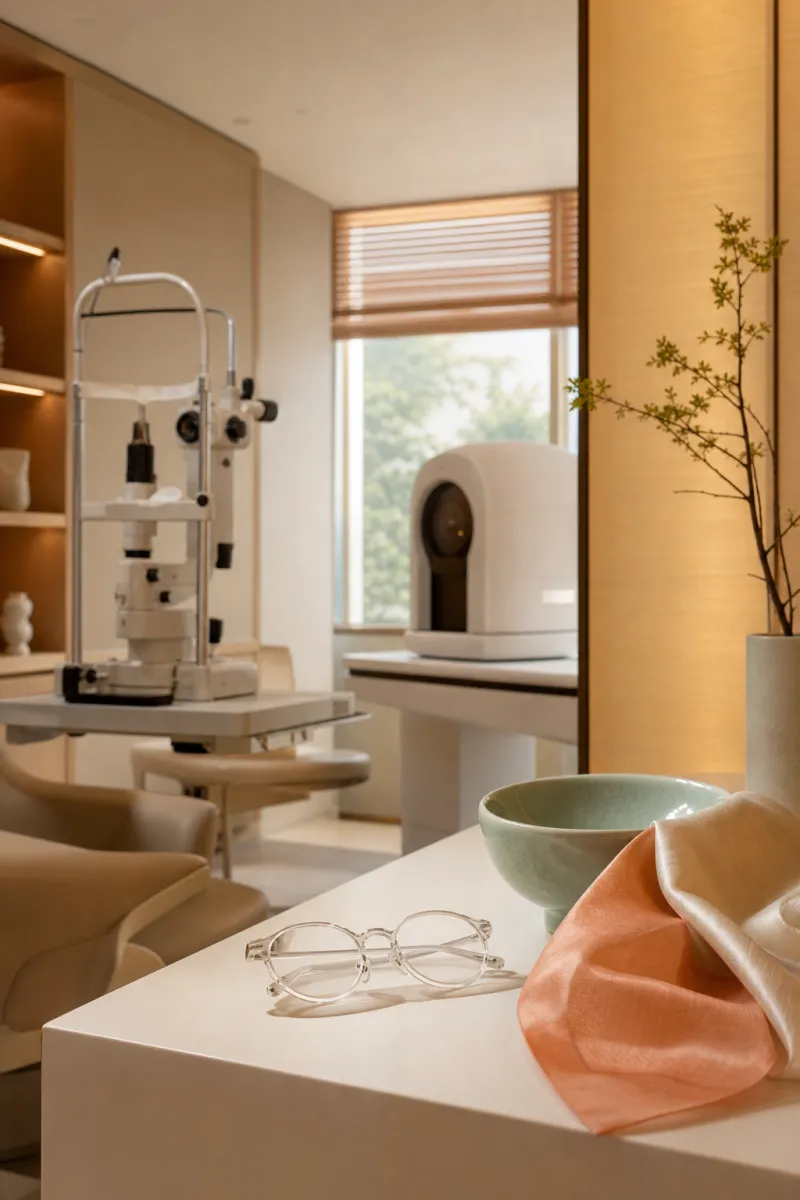
Vision correction in Korea is not one operation but four: LASIK, SMILE, surface laser (LASEK or PRK) and a lens implant (ICL). For readers with high myopia or thin corneas, the laser routes can narrow or close, and an implant, which removes no corneal tissue, is often the procedure considered instead. The examination settles which routes stay open, so the trip should be planned around that visit and not around a procedure chosen in advance.
Clinics in Korea
10 clinics for Vision correction in Korea
| # | Clinic | Devices & products | Area | Languages | Listed price | Google rating |
|---|---|---|---|---|---|---|
| 1 | Clear Seoul Eye Clinic | SMILE Pro · SMILE · LASIK · Presbyopia correction | Gangnam Station | English · Español · 日本語 · ไทย | ₩1,490,000 | 5.0 (328) |
| 2 | Healing Eye Clinic | SMILE · LASIK · LASEK | Sinnonhyeon Station | English | ₩2,190,000 | 4.8 (223) |
| 3 | Apgujeong Eye Clinic | SMILE Pro · SMILE · LASIK | Sinsa Station | English · 日本語 · 中文 · Монгол | - | 4.9 (334) |
| 4 | Gangnam Smile Eye Clinic | SMILE · LASIK · LASEK | Gangnam Station | English · Монгол | - | 5.0 (528) |
| 5 | B&VIIT EYE CENTER | SMILE Pro · SMILE · LASIK | Korea | - | - | 4.9 (1,289) |
| 6 | Bright St. Mary's Eye Clinic (BSM, Gangnam) | SMILE · LASIK · LASEK | Gangnam Station | English · 中文 | - | 4.9 (699) |
| 7 | Gangnam Cube Eye Clinic | SMILE · LASIK · LASEK | Gangnam-gu Office Station | English · 中文 · Русский | - | 5.0 (79) |
| 8 | Dream Eye Center | SMILE · LASEK · ICL lens implant | Gangnam Station | English | - | 5.0 (298) |
| 9 | SNU Eye Clinic | SMILE Pro · SMILE · LASIK | Sinsa Station | English · 中文 · Монгол · Русский | - | 4.8 (360) |
| 10 | Share Bright Vision Eye Clinic (Gangnam) | SMILE · LASIK · LASEK | Gangnam Station | English | - | 4.7 (118) |
 1
1. Clear Seoul Eye Clinic
★ 5.0328 Google reviewsClear Seoul Eye Clinic sits a 2-minute walk from Gangnam Station Exit 10, a vision clinic that holds a 5.0 Google rating across 328 reviews. It lists vision correction on its menu. It consults in English, Spanish, Japanese and Thai, and listed vision correction prices start at ₩1,490,000.
Gangnam Station clinic for SMILE, cataract and presbyopia care
- SMILE & LASIK
- Cataract lenses
- Dry eye care
- The site covers SMILE Pro, Personal Eyes LASIK, same-day LASEK, ICL, cataract and glaucoma care.
- A Taiwan-facing version is linked from the language menu alongside Korean and English.
Cataract and presbyopia patients · Traditional Chinese speakers
- Location
- Gangnam Station Exit 10, 154 m (2-minute walk); Sinnonhyeon Station (Line 9 / Sinbundang Line) Exit 7, 10-minute walk
- Languages
- English · Español · 日本語 · ไทย
- Listed price
- From ₩1,490,000
2. Healing Eye Clinic
★ 4.8223 Google reviewsHealing Eye Clinic runs a vision clinic a 1-minute walk from Sinnonhyeon Station; its Google rating is 4.8 from 223 reviews. Vision correction is on its menu. Consultations are available in English, and its listed vision correction price starts from ₩2,190,000.
Sinnonhyeon eye clinic for LASIK, SMILE, ICL and cataract
- Interpreters on site
- Same-price policy
- Late Fridays
- Japanese, Traditional Chinese and English interpreters join consultations, according to the English site.
- Friday hours run until 21:00, and the same surgeon handles the exam, surgery and aftercare.
Cataract lens choices · Japanese or Chinese speakers
- Location
- Sinnonhyeon Station, 1-minute walk
- Languages
- English
- Listed price
- From ₩2,190,000
3. Apgujeong Eye Clinic
★ 4.9334 Google reviewsApgujeong Eye Clinic is a 1-minute walk from Sinsa Station Exit 4, a vision clinic with a 4.9 average from 334 Google reviews. It lists vision correction on its menu. Consultations are available in English, Japanese, Chinese and Mongolian.
Sinsa Station eye clinic for SMILE Pro and ICL
- SMILE & ICL
- Viewable operating rooms
- Sinsa Station
- The English site describes transparent operating rooms and a one-stop implantable lens centre.
- The clinic says it has performed SMILE since 2011 and was an early adopter of SMILE Pro.
SMILE Pro candidates · ICL lens selection
- Location
- Sinsa Station Exit 4 (Line 3 & Shinbundang Line), 1-minute walk
- Languages
- English · 日本語 · 中文 · Монгол
4. Gangnam Smile Eye Clinic
★ 5.0528 Google reviewsGangnam Smile Eye Clinic is a vision clinic a 1-minute walk from Gangnam Station Exit 10, rated 5.0 from 528 Google reviews. Vision correction is on its menu. It consults in English and Mongolian.
Gangnam Station clinic for SMILE, LASEK and cataract care
- SMILE focus
- One-stop care
- Two floors
- The site describes one-stop care covering vision correction, presbyopia, cataract, glaucoma and oculoplastic treatment.
- It closes on Wednesdays, Sundays and public holidays, and lists a Mongolian-language direct line.
SMILE and LASEK candidates · Cataract and presbyopia care
- Location
- Line 2 Gangnam Station Exit 10, 1-minute walk
- Languages
- English · Монгол
 5
5. B&VIIT EYE CENTER
★ 4.91,289 Google reviewsB&VIIT EYE CENTER sits in Korea, a vision clinic that holds a 4.9 Google rating across 1,289 reviews. It lists vision correction on its menu.
Gangnam Station centre for SMILE, ICL and cataract surgery
- Established 1994
- AI-assisted planning
- Same-day option
- Established in 1994, the centre performs SMILE Pro, SMILE, LASIK, LASEK, ICL and cataract surgery.
- An English-speaking coordinator supports international patients, and the site lists four foreign languages.
Thin corneas (LASEK) · English, Japanese, Chinese speakers
- Location
- Korea
6. Bright St. Mary's Eye Clinic (BSM, Gangnam)
★ 4.9699 Google reviewsBright St. Mary's Eye Clinic (BSM, Gangnam) runs a vision clinic a 1-minute walk from Gangnam Station Exit 1; its Google rating is 4.9 from 699 reviews. Vision correction is on its menu. Consultations are available in English and Chinese.
Gangnam Station eye clinic for SMILE, LASEK and ICL
- SMILE & LASEK
- Multi-floor clinic
- Late Fridays
- The clinic describes itself as an early provider of LASIK and LASEK in Korea.
- Listed procedures include Smart Nova Pro, Silk SMILE, 2-DAY LASEK and lens implants.
Lens implant candidates · Friday evening visits
- Location
- Gangnam Station Exit 1, 1-minute walk
- Languages
- English · 中文
7. Gangnam Cube Eye Clinic
★ 5.079 Google reviewsGangnam Cube Eye Clinic is a 1-minute walk from Gangnam-gu Office Station Exit 3, a vision clinic with a 5.0 average from 79 Google reviews. It lists vision correction on its menu. Staff consult in English, Chinese and Russian.
Gangnam-gu Office eye clinic for vision correction and cataract
- Glaucoma & retina
- Four-language guidance
- Sixth-floor clinic
- Care covers SMILE LASIK, ICL, ortho-K lenses, cataract, retina, glaucoma and dry eye.
- Guidance and online inquiries are available in Korean, English, Chinese and Russian.
Multifocal cataract lenses · Russian or Chinese speakers
- Location
- Gangnam-gu Office Station (Line 7 / Suin-Bundang Line) Exit 3-1, 1-minute walk
- Languages
- English · 中文 · Русский
8. Dream Eye Center
★ 5.0298 Google reviewsDream Eye Center is a vision clinic by Gangnam Station Exit 1, rated 5.0 from 298 Google reviews. Vision correction is on its menu. It consults in English.
Gangnam Station eye clinic for SMILE, LASEK and ICL
- Vision correction
- English-speaking staff
- 14th-floor clinic
- The clinic has offered vision correction, presbyopia and cataract surgery and general eye exams since 2000.
- Its English site says English-speaking ophthalmologists and a global care team assist international patients.
High myopia consultations · English-language care
- Location
- Gangnam Station Exit 1 (Line 2 / Shinbundang Line)
- Languages
- English
9. SNU Eye Clinic
★ 4.8360 Google reviewsSNU Eye Clinic sits by Sinsa Station Exit 4, a vision clinic that holds a 4.8 Google rating across 360 reviews. It lists vision correction on its menu. Consultations are available in English, Chinese, Mongolian and Russian.
Sinsa eye clinic for SMILE, ICL and cataract surgery
- SMILE & ICL
- International patients
- Sinsa Station
- The clinic says it has performed SMILE since 2011 and took part in early clinical research.
- The English site describes staff support for international patients.
Toric ICL candidates · SMILE candidates
- Location
- Sinsa Station Exit 4; Nonhyeon Station Exit 8 (158 m straight ahead) - per the Korean site
- Languages
- English · 中文 · Монгол · Русский
10. Share Bright Vision Eye Clinic (Gangnam)
★ 4.7118 Google reviewsShare Bright Vision Eye Clinic (Gangnam) runs a vision clinic a 1-minute walk from Gangnam Station Exit 9; its Google rating is 4.7 from 118 reviews. Vision correction is on its menu. Staff consult in English.
Gangnam eye clinic for cataract, presbyopia and dry eye
- Cataract & presbyopia
- Dry eye care
- Multi-floor centre
- The clinic covers cataract, presbyopia, vision correction, dry eye, retina and oculoplastic care.
- The group also runs an Anyang clinic alongside the Gangnam clinic.
Dry eye treatment · Retina checks
- Location
- Gangnam Station Exit 9, 1-minute walk
- Languages
- English
Prices
Vision correction cost in Korea
Prices below come from the listed clinics' own price lists. Vision-correction and cataract surgery are VAT-exempt medical care in Korea, so the listed price is the price you pay.
Premium Today LASEK
Price at 1 listed clinic · approx. $1,084₩1,490,000Compare clinicsPremium One-day LASIK
Price at 1 listed clinic · approx. $1,520₩2,090,000Compare clinicsPresbyopia LASIK / LASEK
Price at 1 listed clinic · approx. $1,593₩2,190,000Compare clinicsPremium LASIK & LASEK (both eyes)
Price at 1 listed clinic · approx. $1,593₩2,190,000Compare clinicsPresbyopic LASIK & LASEK (both eyes)
Price at 1 listed clinic · approx. $1,811₩2,490,000Compare clinicsZEISS SMILE
Price at 1 listed clinic · approx. $1,818₩2,500,000Compare clinicsClear SMILE LASIK (both eyes)
Price at 1 listed clinic · approx. $2,109₩2,900,000Compare clinicsCataract, LISA tri lens (per eye)
Price at 1 listed clinic · approx. $2,182₩3,000,000Compare clinicsGuide
Why an Eye Clinic May Turn Down LASIK
LASIK cuts a thin flap in the cornea, reshapes the tissue beneath it with an excimer laser and lays the flap back. Both steps consume corneal tissue, and a stronger prescription asks the laser to remove more of it. That arithmetic is why a high prescription and a thin cornea make a difficult pair.
The concern is corneal ectasia, a weakening and bulging of the cornea that is rare but serious. Documented risk factors after LASIK include abnormal corneal topography, a thin cornea, a low thickness of tissue left beneath the flap, young age and high myopia. The share of the cornea altered by the flap plus the laser matters as well, even when the scans looked normal beforehand.
A refusal is therefore a finding, not a lapse in service. A clinic that declines LASIK, or proposes another method after screening, is acting on that evidence. People in contact sports or jobs with a risk of a blow to the eye are often steered toward a flap-free method, because a flap can be displaced by injury. Much that is written about laser eye surgery in Korea assumes the reader will qualify. This overview starts from the opposite case.
Guide
What Remains: Surface Laser, SMILE and Lens Implants
Three alternatives stand behind LASIK. Each exchanges one limitation for another and has its own entry test.
Surface laser is not a free pass for thin corneas: it spares the flap, yet higher corrections bring a greater tendency to haze, and each clinic sets its own limit. A lens implant moves the operation from the cornea to the inside of the eye, which changes the kind of risk involved more than it lowers it. Anyone researching South Korea laser eye surgery with a strong prescription should ask early whether the clinic also performs lens implants. Where it does, an eye that fails one test can be assessed for another route during the same examination.
| Route | What happens to the cornea | Often considered when | Main trade-off | What can still rule it out |
|---|---|---|---|---|
| LASIK | A flap is cut and the tissue under it is reshaped | The prescription is stable and the cornea is thick and regular | The flap can be displaced by injury; dry eye is the most common side effect | A cornea thin for the planned correction, abnormal topography |
| SMILE | A small disc of tissue is cut inside the cornea and removed through a small incision; no flap | Stable myopia, with or without astigmatism | A touch-up usually needs a different technique; early clarity may settle more slowly in some people | A cornea too thin for the correction, signs of ectatic tendency |
| Surface laser (LASEK, PRK) | The outer layer is moved aside or removed and the surface is reshaped; no flap | The cornea is on the thin side for a flap, or eye trauma is a risk | Days of pain and blur; vision takes weeks to a few months to stabilize | A thin or irregular cornea can exclude this too |
| Lens implant (ICL) | No tissue is removed; a lens is placed behind the iris | Moderate to high myopia, or a cornea unsuited to laser | Surgery inside the eye, with checks for as long as the lens is in place | Too little space at the front of the eye, a low endothelial cell count, cataract, glaucoma |
Guide
High Myopia Is a Retina Question Too
A strong minus prescription is more than a focusing error, and no corneal or lens procedure changes what lies behind the optics. Highly myopic eyes carry a higher baseline risk of retinal detachment whether or not they ever have surgery. Correcting the focus leaves that risk where it was, which is why a dilated retinal check belongs in the examination.
The same theme returns decades later, when cataract develops with age. Neuhann and colleagues analyzed 2,356 cases of cataract surgery in high myopia for retinal detachment, in a 2008 paper in the Journal of Cataract and Refractive Surgery. Lundström and colleagues published evidence-based guidelines for cataract surgery, built on a European registry, in the same journal in 2012. The risks of that surgery vary with the condition of the eye.
Eyes that have had LASIK, LASEK or SMILE can still have cataract surgery, but calculating the power of the replacement lens becomes less predictable, so the treatment record is worth keeping for life. An implanted lens is taken out at cataract surgery, and the later surgeon will want its model and power.
Guide
What the Pre-Op Examination Measures
Suitability is settled by measurements, not by a web page. A full examination takes a few hours, and its length varies by clinic.
Dilating drops blur near vision and cause light sensitivity for several hours, so do not plan to drive or do detailed work afterward. Bring current glasses, earlier prescriptions and records of any previous eye surgery.
- Refraction: the prescription itself, and whether it has stopped changing.
- Corneal thickness: how much tissue is available for a laser correction.
- Corneal topography or tomography: the shape map that screens for keratoconus and other ectatic tendencies.
- Pupil size and tear film: part of the standard set; the tear film shows whether dry eye needs attention first.
- Eye pressure and a dilated retinal check: the health of the eye behind the optics.
- Anterior chamber depth and endothelial cell count: added when a lens implant is being considered, because the lens needs room and a healthy inner corneal layer.
Guide
Building a Trip Around an Answer You Do Not Have Yet
The awkward fact for a traveler is that the procedure is unknown until the examination is finished. A visitor may be found unsuitable, or be advised a different method from the one requested, and the itinerary needs room for either outcome.
Contact lenses change the shape of the cornea and must be left out before the measurements. The length of the break depends on the lens type and on the clinic: soft lenses need the shortest, toric soft and rigid gas-permeable lenses longer, and overnight orthokeratology lenses the longest. Confirm the period with the clinic before booking flights.
Length of stay follows the procedure. LASIK and SMILE involve the shortest stays, since early recovery is fast and the first check falls on the day after surgery. Surface laser needs longer, because the clinic removes the bandage contact lens once the surface has healed. A lens implant needs the day-after check plus an early follow-up of eye pressure and lens position, and a toric lens may have to be ordered to measure, so ask about lead time. The clinic states the days; no single figure fits everyone.
Cabin pressure does not harm the eye after these procedures, because no gas is left inside it. The surgeon decides when flying is fine, after the post-operative examination.
Guide
How the Guides on This Site Divide the Subject
This overview maps the options for eyes that standard LASIK does not fit. A second guide follows the lens implant itself, from sizing to long-term checks. A third sets out how to judge an eye hospital by its testing and by what it declines to do. The fourth explains what sits inside a quote for a lens implant. Laser eye surgery cost in Korea appears in the price table as listed prices per procedure, and each clinic card carries what that clinic states about itself.
Here, eye surgery means vision correction, not eyelid or cosmetic work. Korean clinics often attach their own program names to surface laser and to SMILE, so ask which underlying operation a program is before comparing it with anything else.
Guides
Guides on this site
Evidence
Research behind this page
- Retinal detachment after phacoemulsification in high myopia: Analysis of 2356 casesJournal of Cataract and Refractive Surgery · 2008 · doi:10.1016/j.jcrs.2008.06.022
An analysis of 2,356 cases of phacoemulsification cataract surgery in highly myopic eyes, focused on retinal detachment afterward.
- Evidence-based guidelines for cataract surgery: Guidelines based on data in the European Registry of Quality Outcomes for Cataract and Refractive Surgery databaseJournal of Cataract and Refractive Surgery · 2012 · doi:10.1016/j.jcrs.2012.03.006
Guidelines for cataract surgery drawn from a European registry of quality outcomes for cataract and refractive surgery.
FAQ
Questions about Vision correction in Korea
Which clinics offer Vision correction in Korea?
Clinics offering Vision correction in Korea include Clear Seoul Eye Clinic (Gangnam Station), Healing Eye Clinic (Sinnonhyeon Station), Apgujeong Eye Clinic (Sinsa Station), Gangnam Smile Eye Clinic (Gangnam Station) and B&VIIT EYE CENTER (Korea). Each lists Vision correction on its own menu; message the clinic directly to confirm the doctor, product and current price.
Is vision correction in Korea possible with a very high prescription?
Often it is, though the route depends on what the examination finds and not on the prescription alone. A lens implant is often considered for moderate to high myopia, and SMILE is also used for high myopia. The correctable range differs by device, lens product and clinic, so a number on a prescription slip cannot answer the question by itself.
My cornea was called too thin for LASIK at home. Is a second examination worth the trip?
It can be, provided you treat it as an examination trip that may or may not end in surgery. Surface laser is sometimes considered when a cornea is on the thin side for a flap, and a lens implant removes no corneal tissue at all. A thin or irregular cornea can exclude surface laser too, and an implant has entry tests of its own. Bring the earlier scans; a second clinic may reach the same conclusion.
Is laser eye surgery in South Korea a different operation from the one offered elsewhere?
No, the operations are the same internationally recognized procedures: LASIK, SMILE and surface laser in the form of LASEK or PRK. What differs is the naming. Clinics commonly group surface methods under LASEK and add program names of their own, and SMILE Pro refers to SMILE performed on a newer-generation laser platform, not to a separate kind of surgery. Ask the clinic to translate any program name into the underlying operation before comparing it.
Does Korea laser eye surgery rule out cataract surgery later in life?
No, eyes that have had LASIK, LASEK or SMILE can have cataract surgery when the time comes. The difference is that calculating the power of the replacement lens is less predictable in a cornea that has been reshaped. The cataract surgeon should be told about the earlier procedure, and old records help. Ask for the treatment data in writing before leaving.
Does correcting high myopia lower the risk of retinal detachment?
No, the retinal risk of a highly myopic eye stays the same after the focus has been corrected. Laser procedures reshape the cornea and an implant adds a lens; neither changes the back of the eye. Highly myopic eyes have a higher baseline risk of retinal detachment with or without surgery. That is why a dilated retinal check is part of the examination, and why periodic eye checks remain worthwhile afterward.
Will I still need reading glasses after the procedure?
Yes, in time: presbyopia develops with age regardless of which vision correction procedure was done. It is the age-related loss of near focusing, usually noticed from the mid-40s, and no current procedure restores the focusing ability of a young lens. A corneal laser procedure or a lens implant corrects distance focus; it does not stop the natural lens from stiffening.
What happens if the scans suggest keratoconus?
Corneal laser surgery is not suitable when scans suggest keratoconus or another ectatic tendency, and a careful clinic will say so. Screening exists largely to find such corneas beforehand. Whether any other route applies is a decision for the examining doctor, not something to press for. Ask for copies of the corneal maps so that an eye doctor at home can monitor the cornea over time.
Can pregnancy or breastfeeding delay the surgery?
Yes, vision correction is usually postponed during pregnancy, and laser procedures are usually postponed during breastfeeding as well. A prescription that is still changing, active eye infection or inflammation, and uncontrolled dry eye are other common reasons to wait. Mention them when you first contact a clinic, so the examination is not booked for a date when surgery could not go ahead.